Launch offer — valid today only

📄 Digital book in PDF · read it on your phone or print it

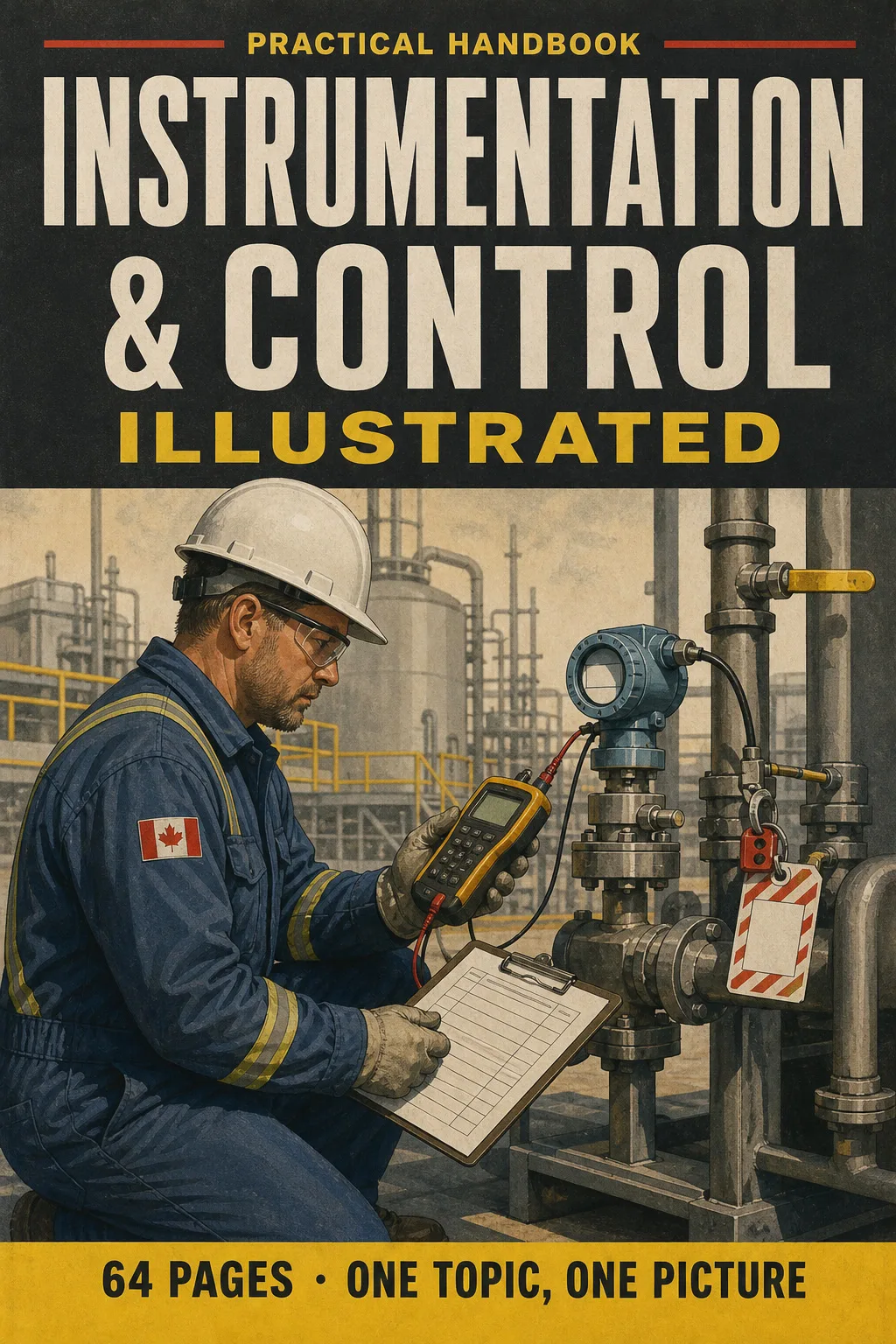
Instrumentation & Control Illustrated: Scale, Range and Tune Every Loop for the Interprovincial Exam, All in Drawings One Topic on Every Page

4-20 mA scaling, DP level and wet legs, orifice flow, thermocouples and Pt100, control valves and fail-safe action, PID tuning and hazardous locations. Every topic has its own page: the drawing first, then what you need to remember. 64 illustrated pages.

START STUDYING THIS WAY

🔒 Secure checkout · PDF by email · 30-day guarantee

Every topic, its own pageEvery loop, valve and calculation drawn, with the explanation beside it
64 illustrated pages9 parts, from range, span and zero to the last week before the exam
Up-to-date sourcesRed Seal Occupational Standard for I&C, CSA C22.1 and provincial apprenticeship guidance
PDF by emailFormat

Look Inside the Book

Every page has one big drawing and a box with the numbers and steps you need to know:

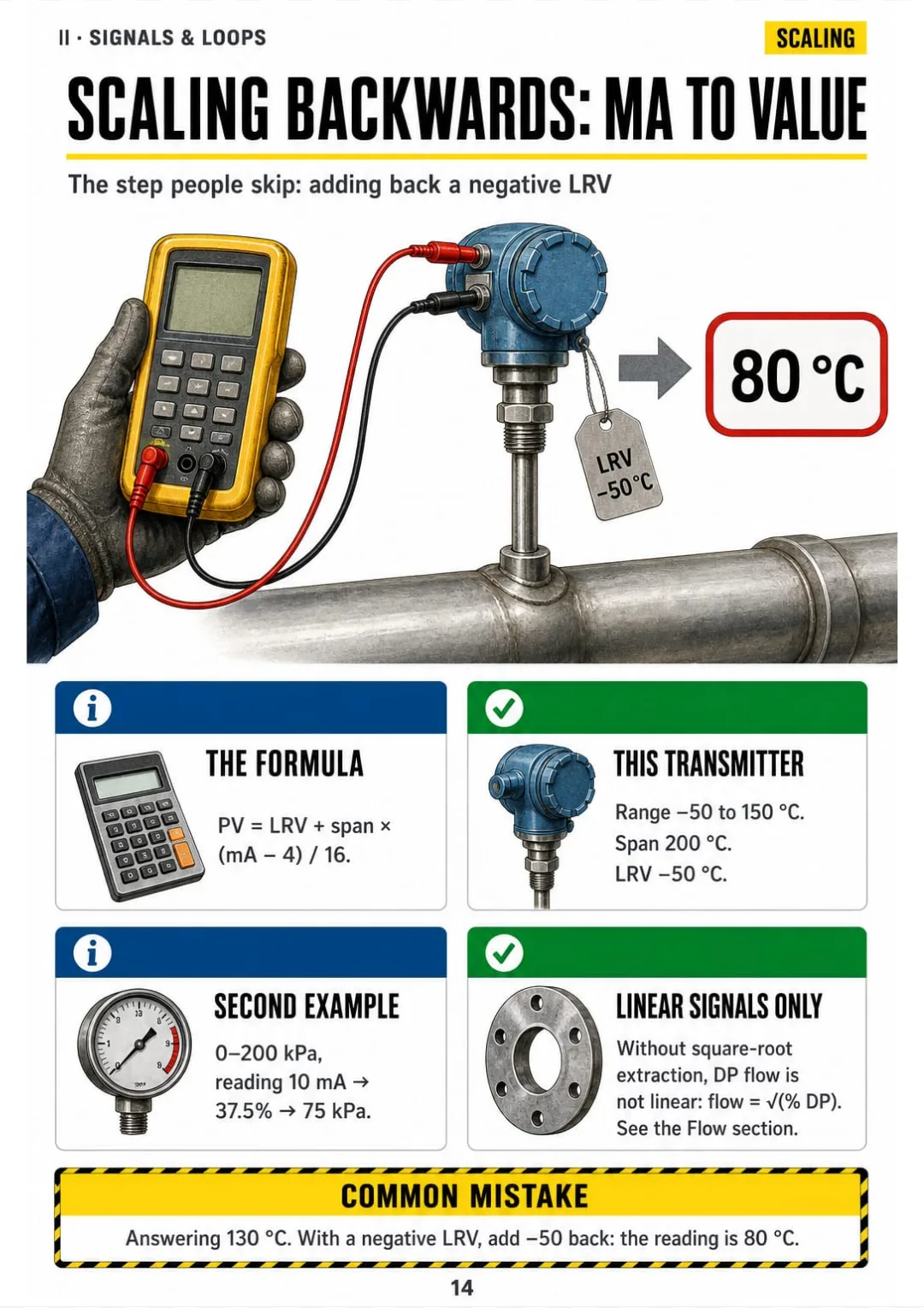
14.4 mA on −50 to 150 °C → 65% → −50 + 130 = 80 °C.
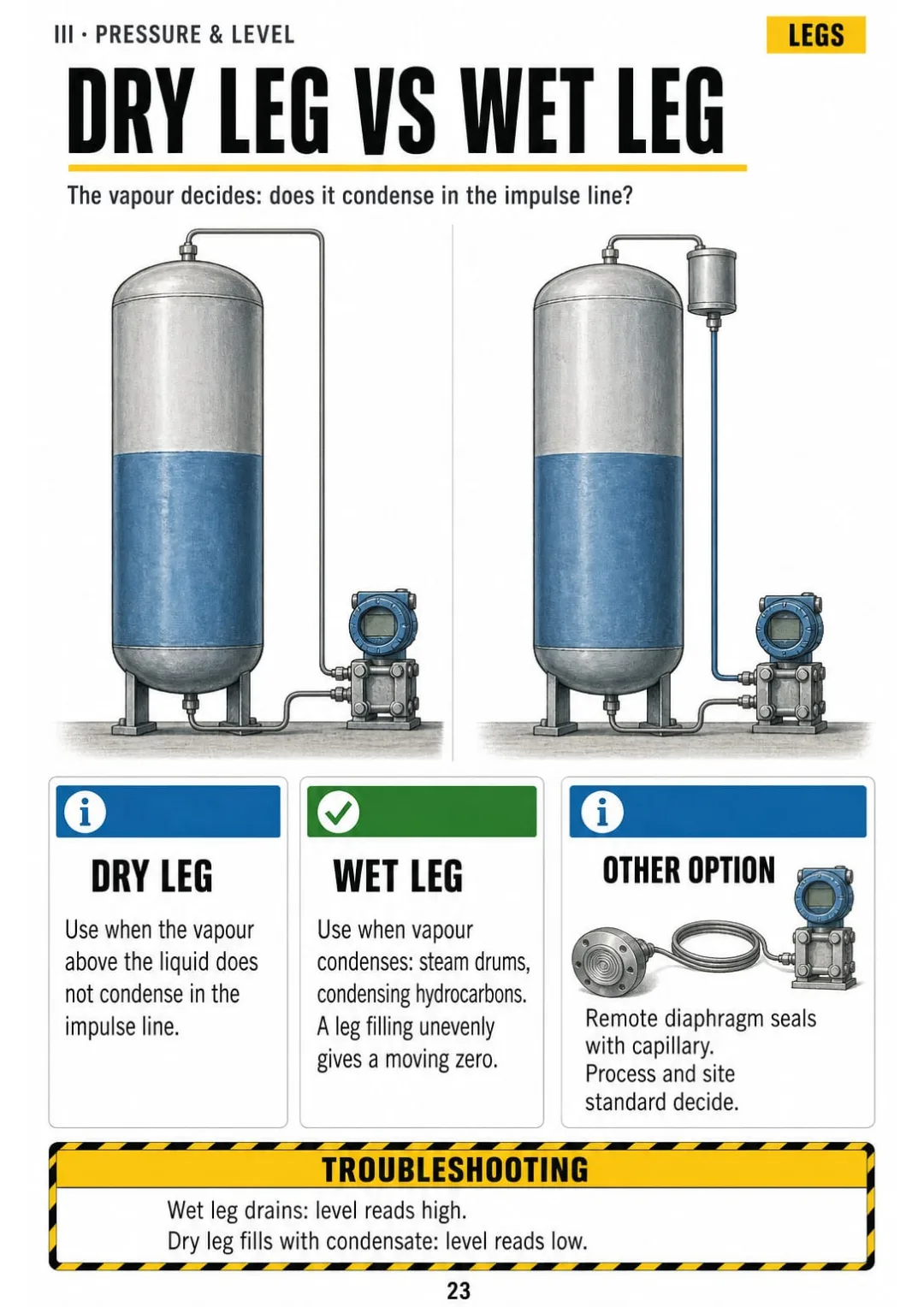
Wet leg drains → reads high. Dry leg fills → reads low.
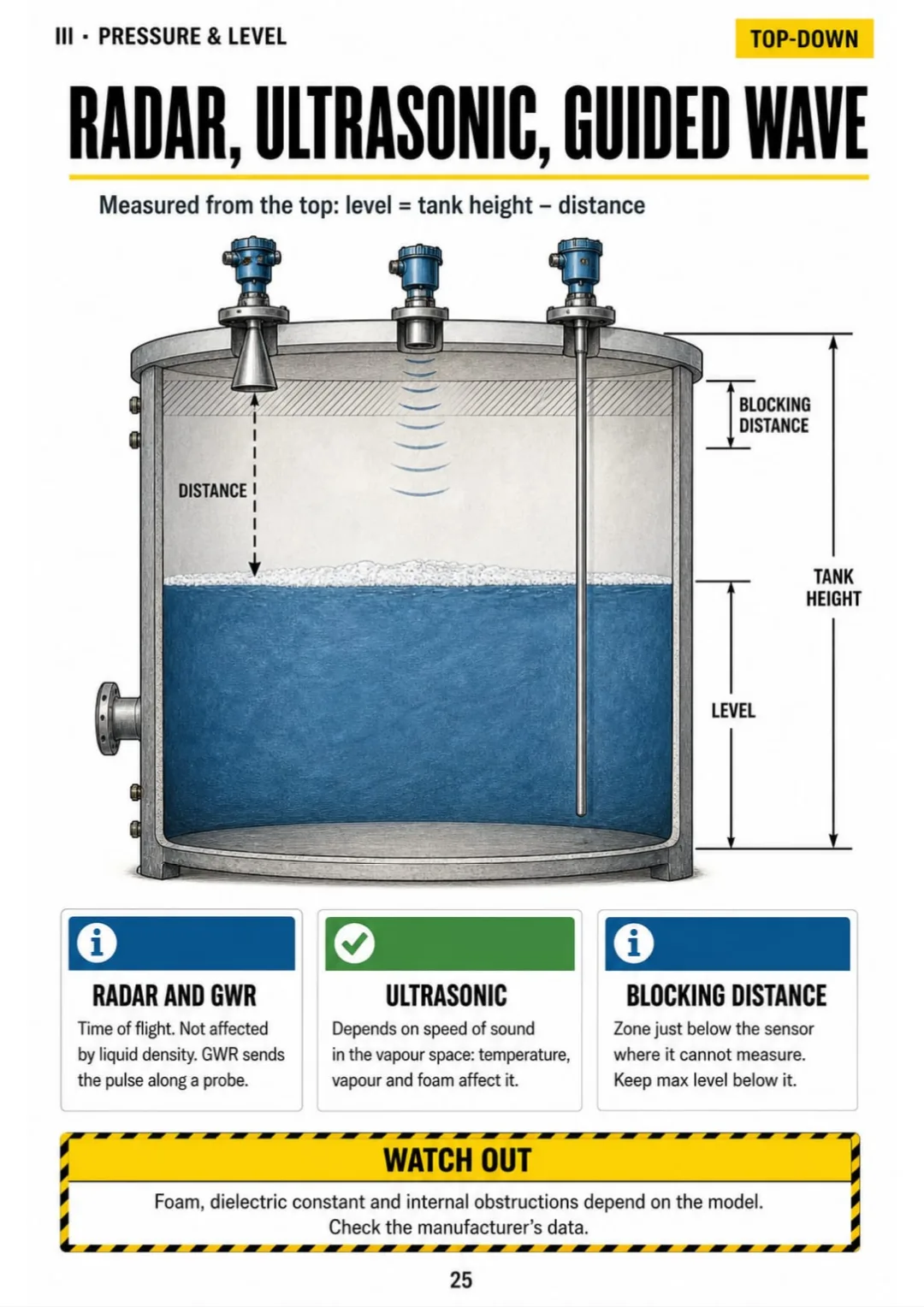
Level = tank height − measured distance; radar ignores density.
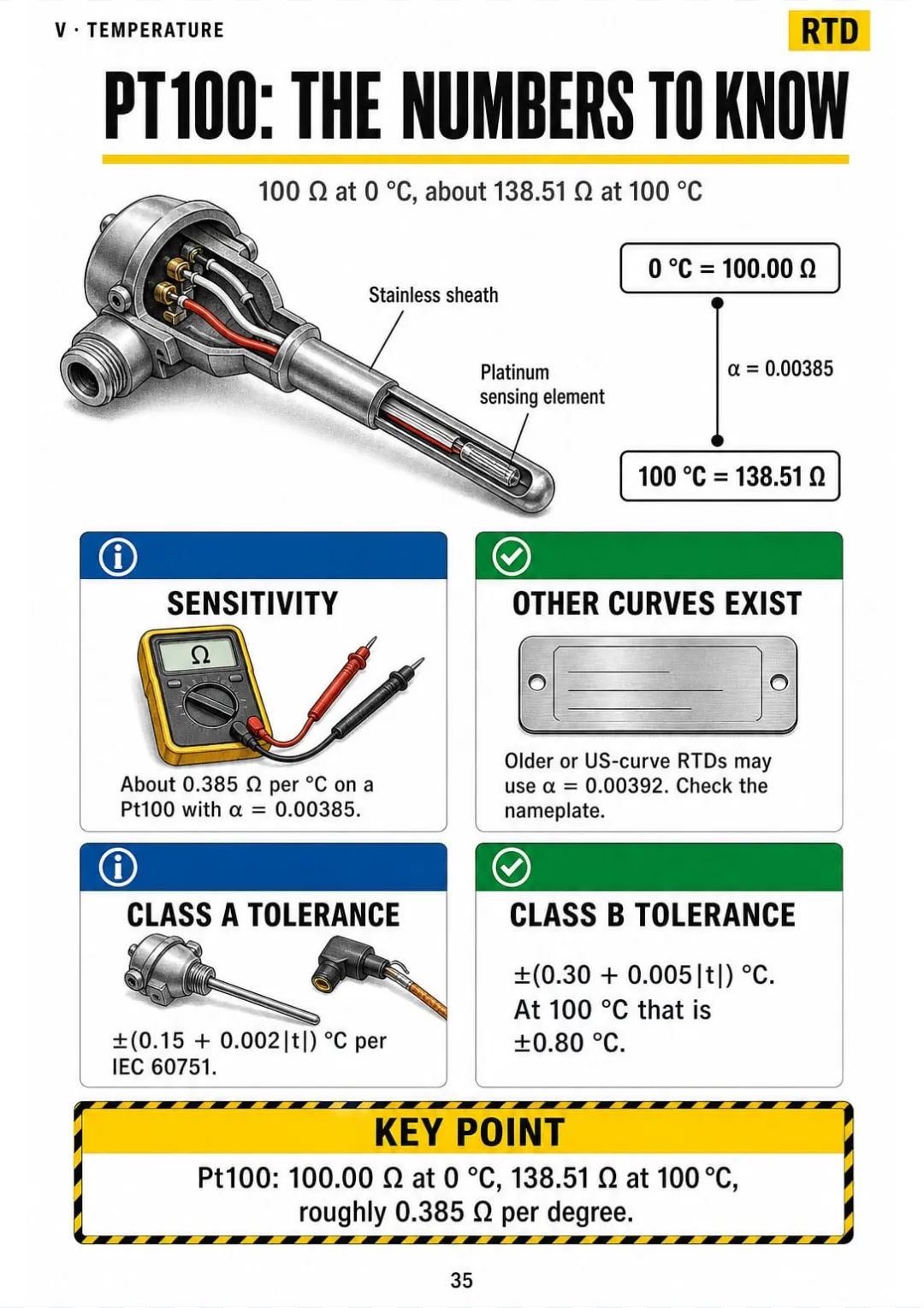
Pt100 = 100.00 Ω at 0 °C · 138.51 Ω at 100 °C · α 0.00385
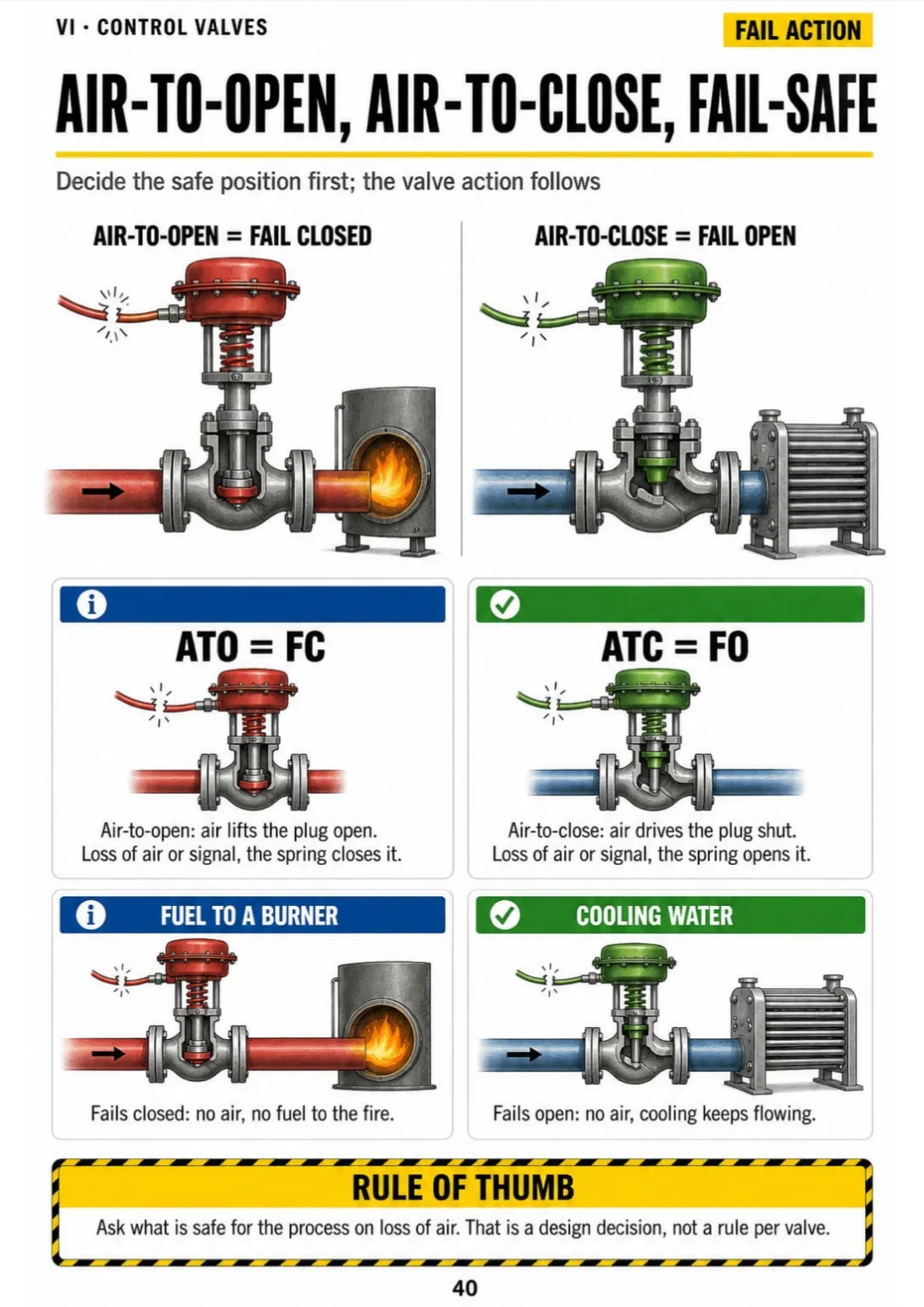
ATO = fail closed (fuel to a burner), ATC = fail open (cooling water).
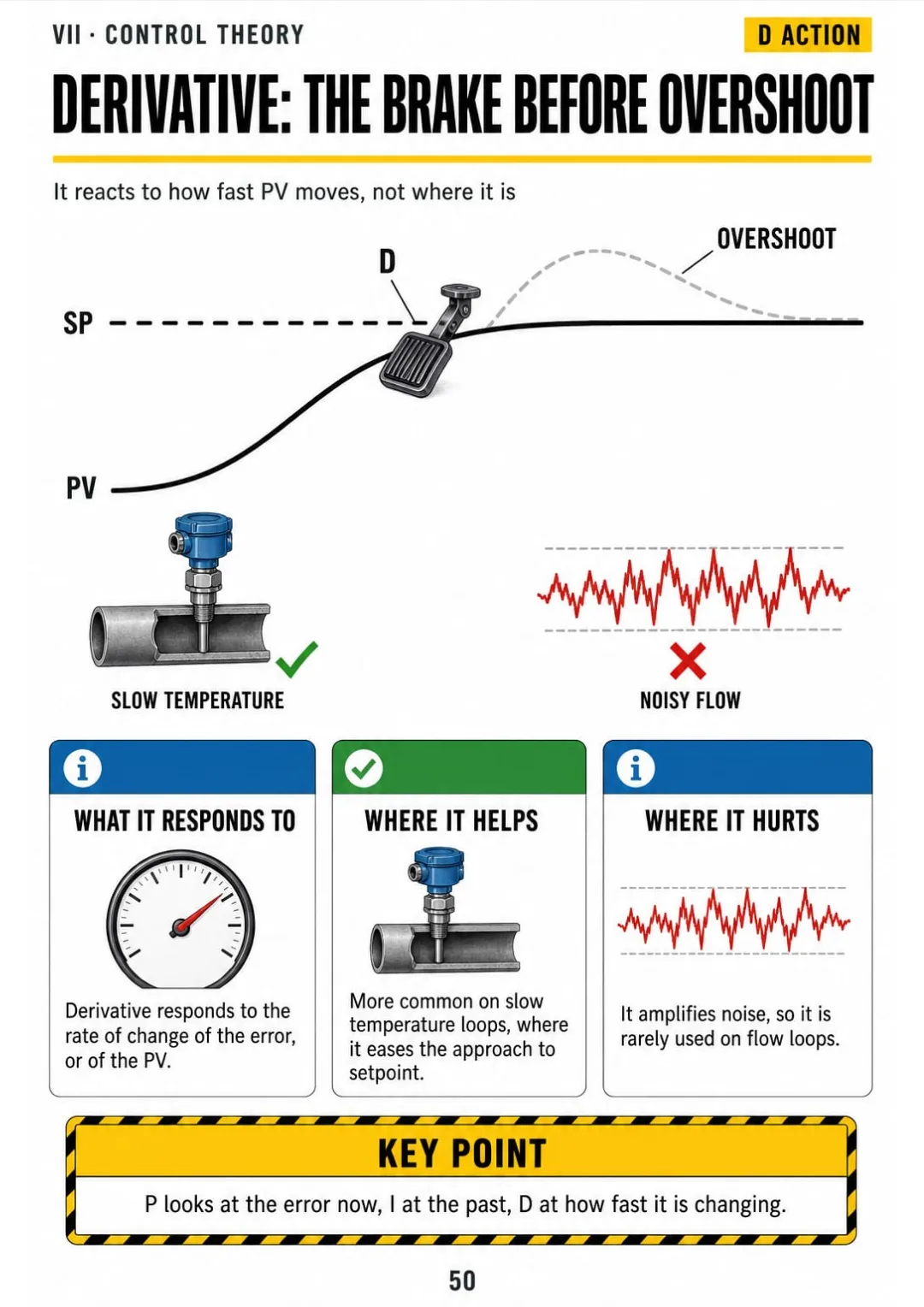
Derivative = rate of change · good on slow temperature, rarely on flow
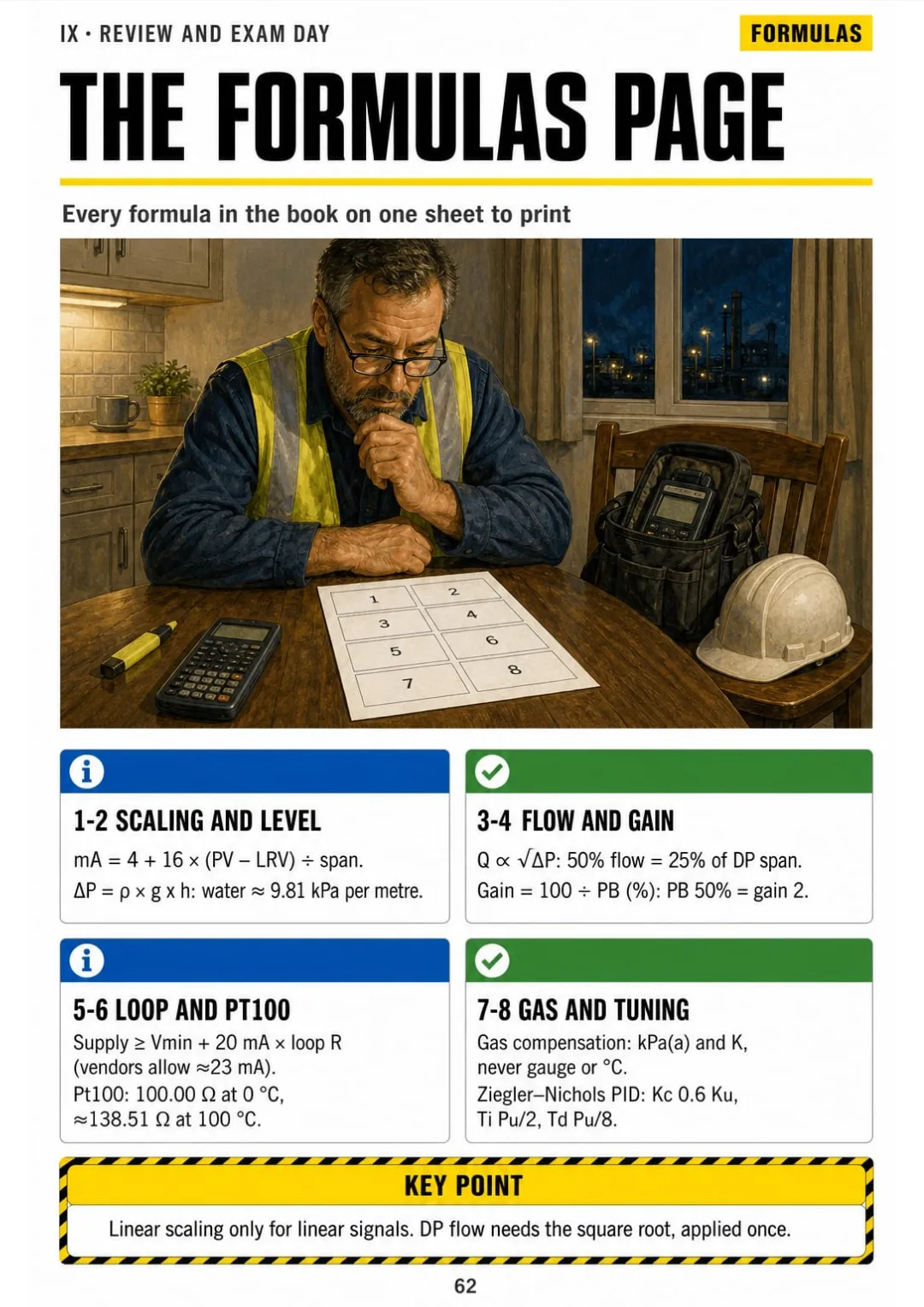
Scaling, ρgh, √ΔP, 100/PB, loop resistance, Pt100, absolute units and Ziegler–Nichols on one sheet
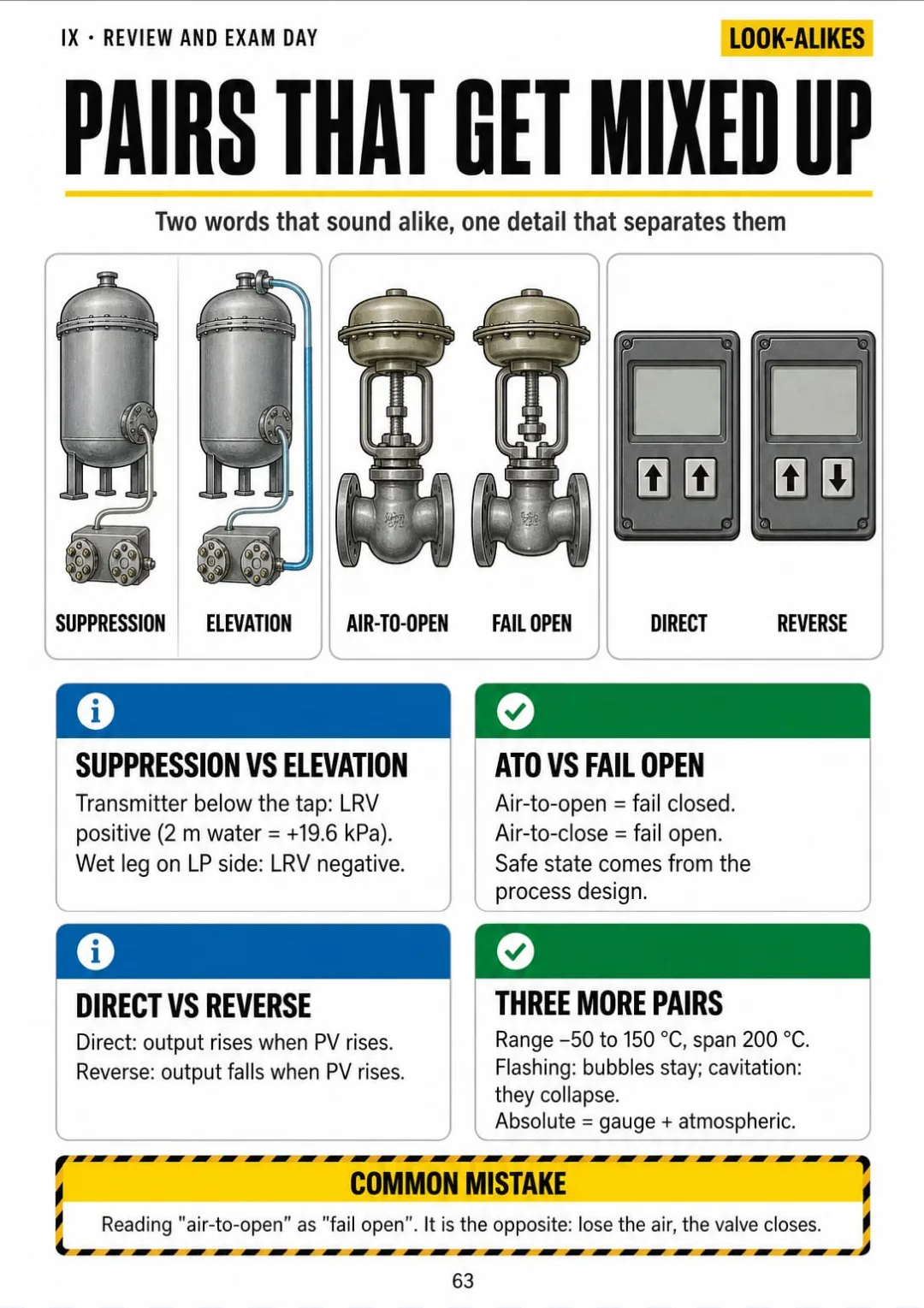
Suppression vs elevation, ATO vs fail open, direct vs reverse, span vs range, flashing vs cavitation, gauge vs absolute

Swipe to see more →

These are real pages from the book. The table of contents is the full one: 9 parts and 60 topics.

The Problem Isn't You. It's How It Was Explained to You.

You're at a closed tank. The DP transmitter sits at the bottom tap, with a filled leg on the low side. The tank is empty, and the reading is about −49 kPa.

You know the job. But the manual covers zero elevation in two dense paragraphs of hydrostatic heads and range shifts, and by the next morning the sign has flipped in your head.

Level = tank height − measured distance; radar ignores density.

In the book, the wet leg is one page: the tank, the 5 m leg drawn in blue, the high and low sides labelled, and the range in a box: about −49.0 to −9.8 kPa for 0 to 4 m of water.

Zero suppression, the 3-valve manifold, the orifice square root, the Pt100 numbers and integral action each get their own page, laid out the same way.

You see why the zero sits below zero, and you set the range yourself, on the bench or on the exam, without going back to the manual.

COMPARE FOR YOURSELF

The Same Topic, Two Ways to Study It

THIS
  • The manual: line after line after line
  • Manifold sequences explained only in words
  • You walk into the exam with doubts
The three-valve manifold permits isolation, equalization and in-service placement of the differential pressure transmitter without subjecting the sensing element to an excessive unilateral static pressure. Prior to placing the instrument in service, the technician shall verify that the equalizing valve is in the open position, whereupon the high-pressure block valve may be opened gradually. The equalizing valve is subsequently closed, isolating the high- and low-pressure chambers, after which the low-pressure block valve is opened. Removal from service is accomplished by essentially the reverse sequence, with due regard to process conditions.
FOR THIS
  • The 3-valve manifold in one drawing
  • The four moves in a box, in order
  • You see it and you get it
Wet leg drains → reads high. Dry leg fills → reads low.
CONTENTS

Take a Look at the 9 Parts and 60 Topics

The basics, signals and loops, pressure and level, flow, temperature, control valves, control theory and PID, safety and hazardous locations, and exam review: 64 pages, all illustrated

IThe Basics Everything Rests On · pp. 5-9
  1. How the Interprovincial I&C Exam Is Built
  2. Canadian Units You Must Convert Without Thinking
  3. Range, Span, Zero: Three Words, Three Numbers
  4. Accuracy, Repeatability, Hysteresis, Deadband
  5. Gauge, Absolute and Differential Pressure
IISignals, Loops and Drawings · pp. 10-17
  1. Reading Tag Letters on a P&ID
  2. P&ID Lines and Symbols
  3. Why 4-20 mA Has a Live Zero
  4. Scaling in Four Steps: Range → % → mA → Units
  5. Scaling Backwards: From mA to the Process Value
  6. 2-Wire, 3-Wire and 4-Wire Transmitters
  7. The Loop Voltage Budget
  8. HART, Pneumatic 20-100 kPa and Digital Buses
IIIPressure and Level · pp. 18-25
  1. Pressure Elements: Bourdon, Diaphragm, Bellows
  2. The DP Transmitter and Its 3-Valve Manifold
  3. Hydrostatic Level: ΔP = ρ × g × h
  4. Zero Suppression: Transmitter Below the Tap
  5. Zero Elevation: The Wet Leg
  6. Dry Leg vs Wet Leg: When to Use Each
  7. Bubbler, Displacer and Float
  8. Radar, Ultrasonic and Guided Wave
IVFlow · pp. 26-32
  1. The Orifice Plate and the Square Root
  2. Square-Root Extraction: Where and Only Once
  3. Orifice Installation: Straight Runs and Taps
  4. Venturi, Flow Nozzle and Pitot
  5. Magnetic Flowmeters
  6. Coriolis, Vortex and Turbine
  7. Volume vs Mass Flow and Gas Compensation
VTemperature · pp. 33-38
  1. Thermocouples: Two Metals, One Voltage
  2. Cold Junction Compensation and Extension Wire
  3. RTDs: Pt100 and Its Numbers
  4. 2-Wire, 3-Wire, 4-Wire RTD
  5. Thermowells and Response Time
  6. Testing a Temperature Loop
VIControl Valves and Final Elements · pp. 39-45
  1. Anatomy of a Globe Control Valve
  2. Air-to-Open, Air-to-Close and Fail-Safe
  3. Direct and Reverse Actuators
  4. The Positioner: When and Why
  5. Valve Characteristics: Quick-Opening, Linear, Equal Percentage
  6. Cv, Cavitation and Flashing
  7. Stroking and Calibrating a Valve
VIIControl Theory and PID · pp. 46-53
  1. The Control Loop: PV, SP, Output, Error
  2. Direct and Reverse Controller Action
  3. Proportional Band and Gain
  4. Integral Action: Removing the Offset
  5. Derivative Action: Reacting to the Rate of Change
  6. On/Off, Cascade, Ratio and Feedforward
  7. Process Lag, Dead Time and Response Curves
  8. Tuning: Ultimate Gain and the Open-Loop Test
VIIISafety, Hazardous Locations and Systems · pp. 54-59
  1. Lockout and Bypass Before Touching a Loop
  2. Hazardous Locations: Zones and Classes
  3. Protection Methods: Ex d, Ex e, Ex i
  4. Intrinsic Safety Barriers and Grounding
  5. Shielding, Grounding and Noise
  6. PLC, DCS and SIS: Who Does What
IXReview and Exam Day · pp. 60-64
  1. Five-Point Calibration, As-Found and As-Left
  2. Troubleshooting a Loop in the Same Order
  3. The Formulas Page
  4. Pairs That Get Mixed Up
  5. The Last Week Before the Exam

One Page, One Topic, All Clear

Think of it this way:

The lead hands you a loop sheet: a temperature transmitter ranged −50 to 150 °C, reading 14.4 mA, and asks what the process is doing.

You open the page on scaling backwards and the path is drawn: mA to percent, percent to span, span to the zero. 65 %, then 130, then 80 °C.

ATO = fail closed (fuel to a burner), ATC = fail open (cooling water).

The same goes for the wet leg, the 3-valve manifold, the globe valve cutaway, the Pt100 numbers and cascade control: each one on its own page.

Instrumentation & Control Illustrated is 9 parts and 60 topics, all drawn, and it ends with a formulas page, the pairs that get mixed up and a plan for the last week before the exam.

What you see drawn, you don't have to memorize.

What's Inside Instrumentation & Control Illustrated:

Ipp. 5-9

The Basics Everything Rests On

How the interprovincial exam is built, the metric units you convert every day, range, span and zero, accuracy, repeatability and hysteresis, and gauge, absolute and differential pressure.

IIpp. 10-17

Signals, Loops and Drawings

Read any P&ID tag and scale any 4-20 mA signal forwards and backwards: the live zero, 2-, 3- and 4-wire transmitters, the loop voltage budget, HART, pneumatic 20-100 kPa and digital buses.

IIIpp. 18-25

Pressure and Level

Set a DP level range yourself, even with a wet leg: Bourdon tubes, diaphragms and bellows, the DP transmitter and its 3-valve manifold, ρgh level, zero suppression and elevation, dry and wet legs, bubblers, displacers, radar and guided wave.

IVpp. 26-32

Flow

The orifice plate and its square root, where to extract it, straight runs and taps, venturi and pitot, magnetic, Coriolis, vortex and turbine meters, and mass versus volume flow.

Vpp. 33-38

Temperature

Thermocouples and cold junction compensation, extension wire, the Pt100 and its numbers, 2-, 3- and 4-wire RTDs, thermowells and how to test a temperature loop.

VIpp. 39-45

Control Valves and Final Elements

The globe valve cut open, air-to-open, air-to-close and fail-safe action, direct and reverse actuators, positioners, valve characteristics, Cv, cavitation and flashing, and stroking a valve.

VIIpp. 46-53

Control Theory and PID

PV, SP, output and error, controller action, proportional band and gain, integral and derivative, cascade, ratio and feedforward, dead time and lag, and tuning by ultimate gain or open loop.

VIIIpp. 54-59

Safety, Hazardous Locations and Systems

Lockout and bypass before touching a loop, hazardous locations by zones and classes, Ex d, Ex e and Ex i, intrinsic safety barriers, shielding and grounding, and who does what in a PLC, DCS and SIS.

IXpp. 60-64

Review and Exam Day

Five-point calibration with as-found and as-left, troubleshooting a loop in the same order, the formulas page, the pairs that get mixed up and the last week before the exam.

At the end of the book: A formulas page, the pairs that get mixed up and a plan for the last week before the exam.
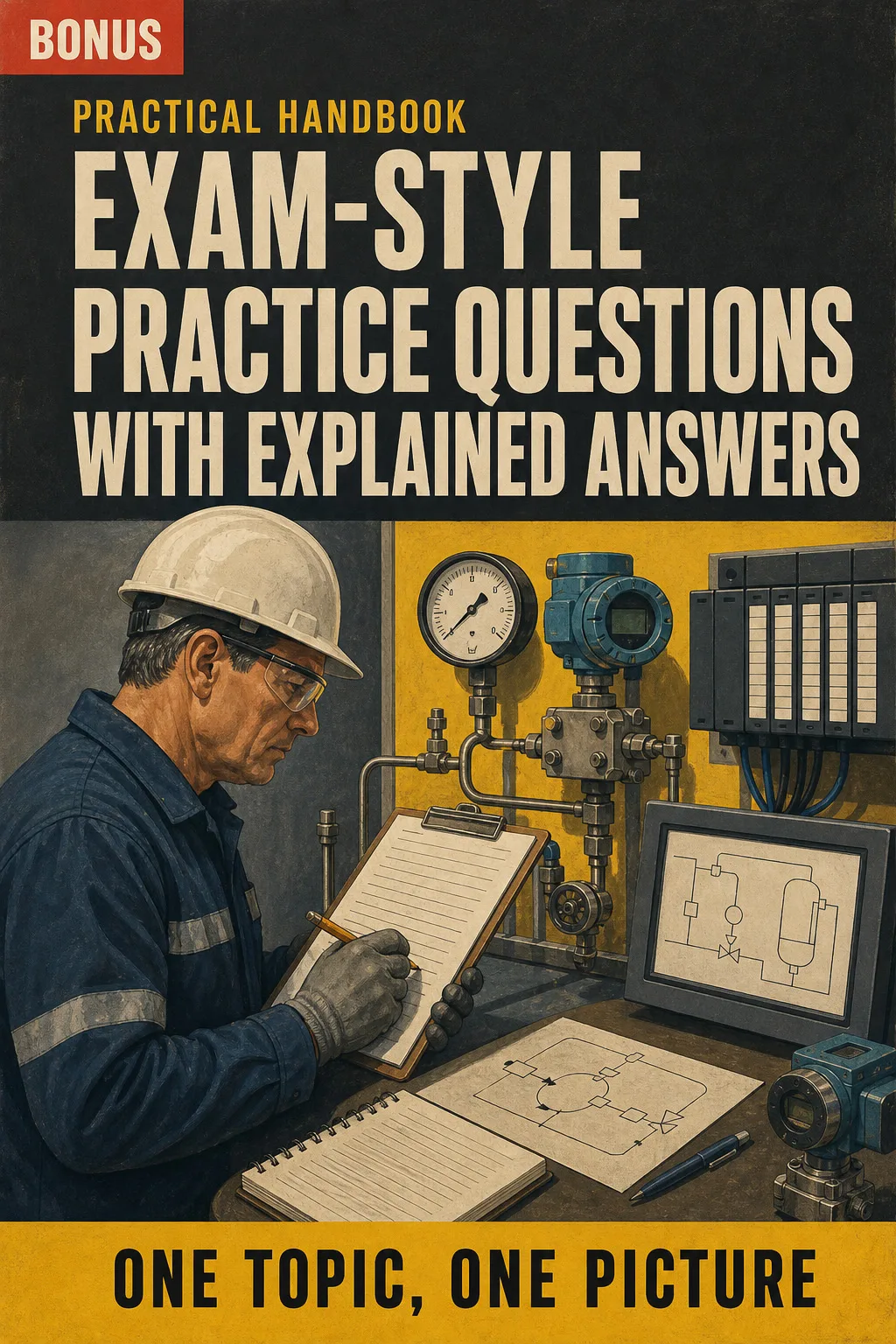

Plus: 2 Free Books

Exam-Style Practice Questions with Explained Answers

BONUS 1: «Exam-Style Practice Questions with Explained Answers»

Value on its own: US$ 17.90

Practise multiple-choice questions in the style of the trade exam, each with a short explanation that sends you back to the right page of the book.

The 15 Most Common I&C Mistakes, Before and After

BONUS 2: «The 15 Most Common I&C Mistakes, Before and After»

Value on its own: US$ 14.90

See the slips that come up most often on the job and in review, from reversed DP legs to wrong fail-safe action, each drawn wrong and then right.

Instrumentation & Control Illustrated with 2 Free Books

  • Instrumentation & Control Illustrated: 64 illustrated pagesUS$ 63
  • BONUS 1: Exam-Style Practice Questions with Explained AnswersUS$ 17.90
  • BONUS 2: The 15 Most Common I&C Mistakes, Before and AfterUS$ 14.90
  • High-resolution PDF to printIncluded
Total value US$ 95.80
YOUR PRICE:
US$ 27
You save US$ 68.80
YES, I WANT INSTRUMENTATION & CONTROL ILLUSTRATED FOR US$ 27

📄 This is a digital PDF book sent to your email: nothing is printed or shipped.

Secure purchaseEncrypted payment30-day guarantee

PDF by email: We email you Instrumentation & Control Illustrated as a PDF, together with the two free books. It's a single payment: no installments, no extra charges.

Who This Book Is For

You're in your last apprenticeship period

You're in your last apprenticeship period

Each topic from your technical training on one page, so the review after a shift or at camp goes in order instead of in circles.

Your exam date is set

Your exam date is set

The formulas page, the pairs that get mixed up and the practice questions to check yourself in the last weeks, with every answer pointing back to its page.

You've worked in the plant for years

You've worked in the plant for years

What you do every day, drawn and named in order, with the scaling, DP level and Pt100 calculations worked out step by step for when you come back to studying as a trade qualifier.

Everything You Get Today

US$ 95.80US$ 27
YES, I WANT INSTRUMENTATION & CONTROL ILLUSTRATED FOR US$ 27

📄 This is a digital PDF book sent to your email: nothing is printed or shipped.

30DAYS
GUARANTEE

30-Day Guarantee

Try Instrumentation & Control Illustrated for 30 days, bonus books included.

We refund everything if the file won't open, if the book isn't what you see here, if you were charged twice or if the email doesn't arrive. Just email us.

You pay once. No subscriptions.

Frequently Asked Questions

Is it for me if I've worked in instrumentation for years and I'm only now writing the exam?

Yes. It doesn't explain what a gauge is: it puts each topic of the trade in order, one per page, with the calculations worked out step by step. It also works if you're in your last apprenticeship period.

Where does the content come from?

It follows the topics of the Red Seal Occupational Standard for Instrumentation and Control Technician, the basis of the interprovincial exam, with CSA C22.1 for hazardous locations, cited descriptively. Metric units throughout, written in English. Requirements vary by province and territory, so check the details with your apprenticeship authority and the current edition of each code.

Is it official material?

No. It's an independent study book. It isn't published, approved or endorsed by the Red Seal Program, CSA Group or any provincial apprenticeship authority, and it doesn't give you a certificate or count toward your apprenticeship hours.

Does it replace my technical training or apprenticeship?

No. It's a review book to use alongside your training, the current codes and the procedures of your site. What it adds to your textbook and notes: each topic reduced to one drawing and one box of numbers, the scaling, DP level and Pt100 calculations worked out step by step, and a formulas page and a last-week plan for the end.

Are the practice questions the ones on the exam?

No. They're written for this book, in a multiple-choice style, and each answer sends you back to the page that explains it.

When and how does it arrive?

As a PDF by email, to the address you enter at checkout. The 2 bonus books come the same way.

Do I have to pay every month?

No. It's a one-time payment.

Can I have it on paper?

We don't ship printed copies. It's a PDF by email that you can print at home or at a print shop and take with you to camp.

How does the refund work?

You have 30 days. We refund everything if the file won't open, if the book isn't what you see on this page, if you were charged twice or if the email doesn't arrive: just email us.

Before You Close This Page

No more rereading the same chapter with nothing sticking.

The wet leg, the manifold and the scaling: you see them drawn, and that's it.

You walk into the exam knowing where each thing is.

Drawings make studying faster.

The book is right below.

One-time payment: US$ 27 · Guarantee: 30 days · PDF by email

YES, I WANT INSTRUMENTATION & CONTROL ILLUSTRATED FOR US$ 27

📄 This is a digital PDF book sent to your email: nothing is printed or shipped.